Blackjack is the one casino game where your decisions change the price. Play every hand the mathematically best way and the house edge drops to about half a percent. Copy the dealer instead and it climbs to about 8%. Same cards, same table, sixteen times the cost. Then the table rules move it again: one payout change adds more than the rest of the rulebook combined. Here’s what each rule costs, what live tables add, and how blackjack fits around a casino bonus.
- Basic strategy lowers the house edge to about 0.4%-0.6%. It does not beat it.
- 6:5 blackjack adds 1.39% to the edge. Skip those tables.
- Live variants like Lightning and Free Bet Blackjack run about 1.0%.
- Bonus weighting for blackjack runs 0%-8% in the terms we read.
Why blackjack’s edge can be so low
Most casino games fix the house edge in the payouts: a European roulette wheel costs 2.70% whatever you do. Blackjack is different because you choose whether to hit, stand, double or split, and those choices change the result.
Basic strategy is the name for the mathematically best decision for every combination of your hand and the dealer’s visible card. Played that way, the house edge sits at about 0.4%-0.6% depending on the rules. Under liberal rules it falls to 0.28%. With an infinite deck, the dealer standing on soft 17, double after split allowed and up to three splits, it’s about 0.51%.
Be clear on what that means: basic strategy lowers the house edge; it never removes it. The casino still keeps a little of every hand on average, and any single session can swing far either way.
Mimicking the dealer is the common alternative: hit until you reach 17, never double, never split. It feels safe, because it’s the dealer’s own rulebook. It hands the house about 8%. That’s worse than an American roulette wheel at 5.26%.
The rules that move the edge
Before you sit down, read the table rules. Each house-friendly rule adds a slice to the edge:
| Rule change (player-friendly to house-friendly) | Added house edge |
|---|---|
| Blackjack pays 3:2 to 6:5 | +1.39% |
| 1 deck to 8 decks | +0.59% |
| Dealer stands on soft 17 to hits soft 17 | +0.22% |
| Double after split allowed to not allowed | +0.14% |
| Double on any two cards to 9-11 only | +0.09% |
| Late surrender allowed to not allowed | +0.08% |
| Re-split aces allowed to not allowed | +0.08% |
Sources: published blackjack odds tables, compiled October 2026.
🧮 What each house-friendly rule adds to the edge
| Blackjack pays 6:5 | +1.39% |
|---|---|
| 8 decks instead of 1 | +0.59% |
| Dealer hits soft 17 | +0.22% |
| No double after split | +0.14% |
| Double on 9-11 only | +0.09% |
| No late surrender | +0.08% |
| No re-splitting aces | +0.08% |
The 6:5 payout towers over the rest. The other six changes added together come to 1.20%; the 6:5 payout alone is 1.39%. A table can look generous on every other rule and still be a poor deal if a blackjack pays 6:5.
The second-biggest lever is the number of decks: going from one deck to eight adds 0.59%. Fewer decks, dealer standing on soft 17 and double after split are the three to look for after the payout.
Reading the rules screen
Online, the rules usually sit behind an info or help button on the table, and live tables print the key ones on the felt. The jargon is short once you know it:
- Blackjack pays 3:2. A two-card 21 pays C$15 on a C$10 bet. At 6:5 the same hand pays C$12. That C$3 per blackjack is where the 1.39% comes from.
- Dealer stands on soft 17 (S17) or hits soft 17 (H17). A soft hand counts an ace as 11. When the dealer must hit a soft 17, the house picks up 0.22%.
- Double after split (DAS). After splitting a pair, you may double down on the new hands. Losing it costs 0.14%.
- Double on any two cards vs 9-11 only. Some tables let you double only on totals of 9, 10 or 11. That restriction costs 0.09%.
- Late surrender. You give up half your bet after the dealer checks for blackjack. Tables that drop it add 0.08%.
- Re-split aces. Whether you can split again if a split ace draws another ace. No re-splitting adds 0.08%.
Two minutes on the rules screen tells you whether you’re sitting at a 0.5% table or something closer to 2%.
What the rules cost in C$
Worked example, illustrative numbers: C$1,000 in total blackjack bets over a few sessions. The 6:5 row adds the published 1.39% to a typical 0.5% table, so treat it as an approximation.
| How you play | House edge | Average cost of C$1,000 in bets |
|---|---|---|
| Basic strategy, liberal rules | 0.28% | C$2.80 |
| Basic strategy, typical rules | about 0.5% | about C$5 |
| Typical table that pays 6:5 | about 1.9% | about C$19 |
| Mimicking the dealer | about 8% | about C$80 |
The gap between the top and bottom rows is the whole story of blackjack. The game is only cheap if both the table and the player are doing their part. Our table games page puts these numbers next to roulette, baccarat, craps and video poker, and the roulette guide shows why the wheel can’t get this low.
🎰 Live blackjack and its variants
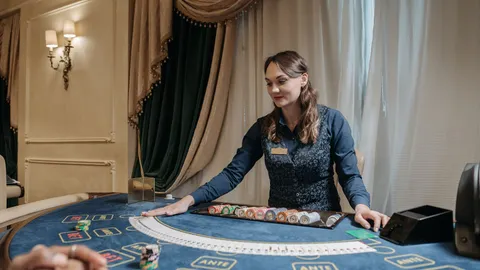
Live blackjack streams a real dealer and shoe from a studio. Standard live blackjack uses the same maths as the digital game with the same rules. Studios also run variants that change the rules, and with them the edge.
🧮 House edge by way of playing blackjack
| Basic strategy, liberal rules | 0.28% |
|---|---|
| Basic strategy, typical (midpoint) | ~0.5% |
| Lightning Blackjack (live) | ~1.0% |
| Free Bet Blackjack (live) | ~1.04% |
| Typical table paying 6:5 | ~1.9% |
| Mimicking the dealer | ~8% |
Lightning Blackjack runs about 1.0% and Free Bet Blackjack about 1.04%: roughly double a well-ruled standard table. They’re not traps, but the extra features have a price. Pragmatic Play Live runs ONE Blackjack and Free Bet Blackjack; Evolution’s titles include Speed Blackjack and Infinite Blackjack.
Live tables also come with limits. As listed for Evolution tables, typically:
| Table type | Minimum bet | Maximum bet |
|---|---|---|
| Infinite Blackjack | $1 | $5,000 |
| Standard seven-seat | $5-$25 | $5,000 |
| VIP tables | $50-$100 | $10,000 |
| Salon Privé | $500+ | $25,000+ |
Source: published live dealer blackjack limits, compiled October 2026. Each casino sets its own limits per table.
The Infinite format has the lowest listed minimum, so it suits small stakes. Evolution also runs a Vancouver studio that grew out of its partnership with BCLC; in July 2023 it added VIP Blackjack tables for the provincial PlayNow site in British Columbia, Manitoba and Saskatchewan. The live casino page covers the studios and game shows in more depth.
Blackjack and bonus wagering
A low house edge makes blackjack look like the ideal game for clearing a bonus. The weighting tables say otherwise. From the published terms of casinos on our list:
| Casino | Blackjack counts | Notes |
|---|---|---|
| Jackpot City | 8% | Classic Blackjack 2% |
| Grizzly’s Quest | 8% | Classic Blackjack 2% |
| Casino Classic | 2% | Live casino also 2% |
| V.Vegas | Excluded | Table games don’t count |
| 20Bet | Excluded | Table and live dealer games don’t count |
Sources: each casino’s published bonus terms and our casino data, read October 2026.
🧮 Worked example, illustrative numbers: a C$1,000 wagering target. At 8%, you need C$12,500 in blackjack bets; at a 0.5% edge that averages about C$62.50. At 2%, it’s C$50,000 in bets and about C$250. The same target on a 96% RTP slot at full weighting averages C$40. So even at 8%, perfect basic strategy clears a bonus for more than slots would, and at 2% it isn’t close.
The practical route: clear a bonus on slots, then play blackjack with cash. Our wagering requirements guide covers the formula, the wagering calculator runs any offer, and wager-free bonuses skip the problem entirely.
Your table checklist
- Read the blackjack payout. 3:2 or walk away from 6:5.
- Learn basic strategy for the rules you play. It’s the only tool that lowers the edge, and it lowers it a lot.
- Prefer fewer decks and a dealer who stands on soft 17, when you get the choice.
- Know the variant. Lightning and Free Bet tables cost about twice a standard table.
- Keep bonus money off the table unless the terms count blackjack and you’ve done the maths.
If you’re starting small, our low deposit casinos let you try a table without a big first payment. Baccarat is the other low-edge card game, with its own trap bet, covered in our baccarat guide.
🍁 For players in Canada
Our casinos serve players aged 19 or over outside Ontario and Alberta, which run their own regulated markets. Even perfect play leaves the house a small edge on every hand. Set a deposit limit before you sit down, and see our responsible gambling page for every provincial helpline.
FAQ
What is the house edge in online blackjack?
With basic strategy, about 0.4%-0.6% depending on the table rules, and as low as 0.28% under liberal rules. Copy the dealer's strategy instead and the edge climbs to about 8%. The same table can be one of the cheapest or one of the costliest games in the casino, depending on how you play it.
Why should I avoid 6:5 blackjack?
A blackjack that pays 6:5 instead of 3:2 adds about 1.39% to the house edge. That's more than every other common rule change in the published tables combined. Check the payout printed on the table or in the game rules before you place a bet.
Does basic strategy remove the house edge?
No. Basic strategy is the mathematically best play for each hand, and it lowers the house edge to about 0.4%-0.6% on typical rules. The casino still keeps that edge over the long run. It's the cheapest way to play, not a way to win.
What are typical live blackjack limits?
As listed for Evolution tables: Infinite Blackjack runs about $1 to $5,000, standard seven-seat tables $5-$25 up to $5,000, and VIP tables $50-$100 up to $10,000. Each casino sets its own limits per table, so check the table before you sit down.
Does blackjack count toward bonus wagering?
Partly, at best. In the terms we read, blackjack counts 8% at Jackpot City and Grizzly's Quest (Classic Blackjack 2%), 2% at Casino Classic, and is excluded at V.Vegas and 20Bet. A C$1,000 wagering target at 8% needs C$12,500 in blackjack bets.